Claude Code Plugins: Orchestration and Automation
⚡ Updated for Opus 4.7, Sonnet 4.6 & Haiku 4.5 — Three-tier model strategy for optimal performance

🎯 Agent Skills Enabled — 150 specialized skills extend Claude's capabilities across plugins with progressive disclosure
A comprehensive production-ready system combining 184 specialized AI agents, 16 multi-agent workflow orchestrators, 150 agent skills, and 98 commands organized into 78 focused, single-purpose plugins for Claude Code.
Overview
This unified repository provides everything needed for intelligent automation and multi-agent orchestration across modern software development:
- 78 Focused Plugins - Granular, single-purpose plugins optimized for minimal token usage and composability
- 184 Specialized Agents - Domain experts with deep knowledge across architecture, languages, infrastructure, quality, data/AI, documentation, business operations, and SEO
- 150 Agent Skills - Modular knowledge packages with progressive disclosure for specialized expertise
- 16 Workflow Orchestrators - Multi-agent coordination systems for complex operations like full-stack development, security hardening, ML pipelines, and incident response
- 98 Commands - Optimized utilities including project scaffolding, security scanning, test automation, and infrastructure setup
Key Features
- Granular Plugin Architecture: 78 focused plugins optimized for minimal token usage
- Comprehensive Tooling: 98 commands including test generation, scaffolding, and security scanning
- 100% Agent Coverage: All plugins include specialized agents
- Agent Skills: 150 specialized skills following for progressive disclosure and token efficiency
- Clear Organization: 25 categories with 1-10 plugins each for easy discovery
- Efficient Design: Average 3.6 components per plugin (follows Anthropic's 2-8 pattern)
How It Works
Each plugin is completely isolated with its own agents, commands, and skills:
- Install only what you need - Each plugin loads only its specific agents, commands, and skills
- Minimal token usage - No unnecessary resources loaded into context
- Mix and match - Compose multiple plugins for complex workflows
- Clear boundaries - Each plugin has a single, focused purpose
- Progressive disclosure - Skills load knowledge only when activated
Example: Installing python-development loads 3 Python agents, 1 scaffolding tool, and makes 16 skills available (~1000 tokens), not the entire marketplace.
Quick Start
Step 1: Add the Marketplace
Add this marketplace to Claude Code:
/plugin marketplace add wshobson/agents
This makes all 78 plugins available for installation, but does not load any agents or tools into your context.
Step 2: Install Plugins
Browse available plugins:
/plugin
Install the plugins you need:
/plugin install python-development
/plugin install javascript-typescript
/plugin install backend-development
/plugin install kubernetes-operations
/plugin install cloud-infrastructure
/plugin install security-scanning
/plugin install comprehensive-review
/plugin install full-stack-orchestration
Each installed plugin loads only its specific agents, commands, and skills into Claude's context.
Plugins vs Agents
You install plugins, which bundle agents:
| Plugin |
Agents |
comprehensive-review |
architect-review, code-reviewer, security-auditor |
javascript-typescript |
javascript-pro, typescript-pro |
python-development |
python-pro, django-pro, fastapi-pro |
blockchain-web3 |
blockchain-developer |
/plugin install typescript-pro
/plugin install javascript-typescript@claude-code-workflows
Troubleshooting
"Plugin not found" → Use plugin names, not agent names. Add @claude-code-workflows suffix.
Plugins not loading → Clear cache and reinstall:
rm -rf ~/.claude/plugins/cache/claude-code-workflows && rm ~/.claude/plugins/installed_plugins.json
Documentation
Core Guides
Quick Links
What's New
PluginEval — Quality Evaluation Framework (NEW)
A three-layer evaluation framework for measuring and certifying plugin/skill quality:
/plugin install plugin-eval@claude-code-workflows
- Three Evaluation Layers — Static analysis (instant), LLM judge (semantic), Monte Carlo simulation (statistical)
- 10 Quality Dimensions — Triggering accuracy, orchestration fitness, output quality, scope calibration, progressive disclosure, token efficiency, robustness, structural completeness, code template quality, ecosystem coherence
- Quality Badges — Platinum (★★★★★), Gold (★★★★), Silver (★★★), Bronze (★★)
- Anti-Pattern Detection — OVER_CONSTRAINED, EMPTY_DESCRIPTION, MISSING_TRIGGER, BLOATED_SKILL, ORPHAN_REFERENCE, DEAD_CROSS_REF
- Statistical Rigor — Wilson score CI, bootstrap CI, Clopper-Pearson exact CI, Elo ranking
- CLI + Claude Code —
uv run plugin-eval score/certify/compare or /eval, /certify, /compare commands
- CI Gate —
--threshold flag exits non-zero below a minimum score
uv run plugin-eval score path/to/skill --depth quick
uv run plugin-eval score path/to/skill --depth standard
uv run plugin-eval certify path/to/skill
→ View PluginEval documentation
Agent Teams Plugin
Orchestrate multi-agent teams for parallel workflows using Claude Code's experimental Agent Teams feature:
/plugin install agent-teams@claude-code-workflows
- 7 Team Presets —
review, debug, feature, fullstack, research, security, migration
- Parallel Code Review —
/team-review src/ --reviewers security,performance,architecture
- Hypothesis-Driven Debugging —
/team-debug "API returns 500" --hypotheses 3
- Parallel Feature Development —
/team-feature "Add OAuth2 auth" --plan-first
- Research Teams — Parallel investigation across codebase and web sources
- Security Audits — 4 reviewers covering OWASP, auth, dependencies, and secrets
- Migration Support — Coordinated migration with parallel streams and correctness verification
Includes 4 specialized agents, 7 commands, and 6 skills with reference documentation.
→ View agent-teams documentation
Conductor Plugin — Context-Driven Development
Transforms Claude Code into a project management tool with a structured Context → Spec & Plan → Implement workflow:
/plugin install conductor@claude-code-workflows
- Interactive Setup —
/conductor:setup creates product vision, tech stack, workflow rules, and style guides
- Track-Based Development —
/conductor:new-track generates specifications and phased implementation plans
- TDD Workflow —
/conductor:implement executes tasks with verification checkpoints
- Semantic Revert —
/conductor:revert undoes work by logical unit (track, phase, or task)
- State Persistence — Resume setup across sessions with persistent project context
- 3 Skills — Context-driven development, track management, workflow patterns
→ View Conductor documentation
Agent Skills (150 skills across 37 plugins)
Specialized knowledge packages following Anthropic's progressive disclosure architecture:
Language Development:
- Python (5 skills): async patterns, testing, packaging, performance, UV package manager
- JavaScript/TypeScript (4 skills): advanced types, Node.js patterns, testing, modern ES6+
Infrastructure & DevOps:
- Kubernetes (4 skills): manifests, Helm charts, GitOps, security policies
- Cloud Infrastructure (4 skills): Terraform, multi-cloud, hybrid networking, cost optimization
- CI/CD (4 skills): pipeline design, GitHub Actions, GitLab CI, secrets management
Development & Architecture:
- Backend (3 skills): API design, architecture patterns, microservices
- LLM Applications (8 skills): LangGraph, prompt engineering, RAG, evaluation, embeddings, similarity search, vector tuning, hybrid search
Blockchain & Web3 (4 skills): DeFi protocols, NFT standards, Solidity security, Web3 testing
Project Management:
- Conductor (3 skills): context-driven development, track management, workflow patterns
And more: Framework migration, observability, payment processing, ML operations, security scanning
→ View complete skills documentation
Three-Tier Model Strategy
Strategic model assignment for optimal performance and cost:
| Tier |
Model |
Agents |
Use Case |
| Tier 1 |
Opus 4.7 |
42 |
Critical architecture, security, ALL code review, production coding (language pros, frameworks) |
| Tier 2 |
Inherit |
42 |
Complex tasks - user chooses model (AI/ML, backend, frontend/mobile, specialized) |
| Tier 3 |
Sonnet |
51 |
Support with intelligence (docs, testing, debugging, network, API docs, DX, legacy, payments) |
| Tier 4 |
Haiku |
18 |
Fast operational tasks (SEO, deployment, simple docs, sales, content, search) |
Why Opus 4.7 for Critical Agents?
- 80.8% on SWE-bench (industry-leading)
- 65% fewer tokens for complex tasks
- Best for architecture decisions and security audits
Tier 2 Flexibility (inherit):
Agents marked inherit use your session's default model, letting you balance cost and capability:
- Set via
claude --model opus or claude --model sonnet when starting a session
- Falls back to Sonnet 4.6 if no default specified
- Perfect for frontend/mobile developers who want cost control
- AI/ML engineers can choose Opus for complex model work
Cost Considerations:
- Opus 4.7: $5/$25 per million input/output tokens - Premium for critical work
- Sonnet 4.6: $3/$15 per million tokens - Balanced performance/cost
- Haiku 4.5: $1/$5 per million tokens - Fast, cost-effective operations
- Opus's 65% token reduction on complex tasks often offsets higher rate
- Use
inherit tier to control costs for high-volume use cases
Orchestration patterns combine models for efficiency:
Opus (architecture) → Sonnet (development) → Haiku (deployment)
→ View model configuration details
Popular Use Cases
Full-Stack Feature Development
/full-stack-orchestration:full-stack-feature "user authentication with OAuth2"
Coordinates 7+ agents: backend-architect → database-architect → frontend-developer → test-automator → security-auditor → deployment-engineer → observability-engineer
→ View all workflow examples
Security Hardening
/security-scanning:security-hardening --level comprehensive
Multi-agent security assessment with SAST, dependency scanning, and code review.
Python Development with Modern Tools
/python-development:python-scaffold fastapi-microservice
Creates production-ready FastAPI project with async patterns, activating skills:
async-python-patterns - AsyncIO and concurrencypython-testing-patterns - pytest and fixturesuv-package-manager - Fast dependency management
Kubernetes Deployment
"Create production Kubernetes deployment with Helm chart and GitOps"
Uses kubernetes-architect agent with 4 specialized skills for production-grade configs.
→ View complete usage guide
Plugin Categories
25 categories, 78 plugins:
- 🎨 Development (6) - debugging, backend, frontend, multi-platform
- 📚 Documentation (4) - code docs, API specs, diagrams, C4 architecture, HADS (Human-AI Document Standard)
- 🔄 Workflows (5) - git, full-stack, TDD, Conductor (context-driven development), Agent Teams (multi-agent orchestration)
- ✅ Testing (2) - unit testing, qa-orchestra (multi-agent QA toolkit with Chrome MCP validation)
- 🔍 Quality (3) - comprehensive review, performance
- 🤖 AI & ML (4) - LLM apps, agent orchestration, context, MLOps
- 📊 Data (2) - data engineering, data validation
- 🗄️ Database (2) - database design, migrations
- 🚨 Operations (4) - incident response, diagnostics, distributed debugging, observability
- ⚡ Performance (2) - application performance, database/cloud optimization
- ☁️ Infrastructure (5) - deployment, validation, Kubernetes, cloud, CI/CD
- 🔒 Security (6) - scanning, compliance, backend/API, frontend/mobile, block-no-verify (git hook bypass guard)
- 🛡️ Governance (1) - protect-mcp (Cedar policy enforcement + Ed25519 signed receipts)
- 💻 Languages (10) - Python, JS/TS, systems, JVM, scripting, functional, embedded
- 🔗 Blockchain (1) - smart contracts, DeFi, Web3
- 💰 Finance (1) - quantitative trading, risk management
- 💳 Payments (1) - Stripe, PayPal, billing
- 🎮 Gaming (1) - Unity, Minecraft plugins
- 🎨 Creative (1) - creative tooling
- ♿ Accessibility (1) - WCAG and a11y
- 📢 Marketing (4) - SEO content, technical SEO, SEO analysis, content marketing
- 💼 Business (4) - analytics, HR/legal, customer/sales
- 🔌 API (2) - API tooling
- 🛠️ Utilities (4) - general-purpose helpers
- 🔧 Modernization (2) - legacy migration and refactoring
→ View complete plugin catalog
Related Plugins
Plugins hosted in their own marketplaces — install from the source for the latest releases:
-
Pensyve — Universal memory runtime with cross-session cognitive memory for Claude Code. Intelligent capture, entity-aware recall, 6 commands, 4 skills, 2 agents, and 6 lifecycle hooks.
/plugin marketplace add major7apps/pensyve
/plugin install pensyve@major7apps-pensyve
Architecture Highlights
Granular Design
- Single responsibility - Each plugin does one thing well
- Minimal token usage - Average 3.6 components per plugin
- Composable - Mix and match for complex workflows
- 100% coverage - All 184 agents accessible across plugins
Progressive Disclosure (Skills)
Three-tier architecture for token efficiency:
- Metadata - Name and activation criteria (always loaded)
- Instructions - Core guidance (loaded when activated)
- Resources - Examples and templates (loaded on demand)
Repository Structure
claude-agents/
├── .claude-plugin/
│ └── marketplace.json
├── plugins/
│ ├── python-development/
│ │ ├── agents/
│ │ ├── commands/
│ │ └── skills/
│ ├── kubernetes-operations/
│ │ ├── agents/
│ │ ├── commands/
│ │ └── skills/
│ └── ... (67 more plugins)
├── docs/
└── README.md
→ View architecture details
Contributing
To add new agents, skills, or commands:
- Identify or create the appropriate plugin directory in
plugins/
- Create
.md files in the appropriate subdirectory:
agents/ - For specialized agentscommands/ - For tools and workflowsskills/ - For modular knowledge packages
- Follow naming conventions (lowercase, hyphen-separated)
- Write clear activation criteria and comprehensive content
- Update the plugin definition in
.claude-plugin/marketplace.json
See Architecture Documentation for detailed guidelines.
Resources
Documentation
This Repository
License
MIT License - see LICENSE file for details.
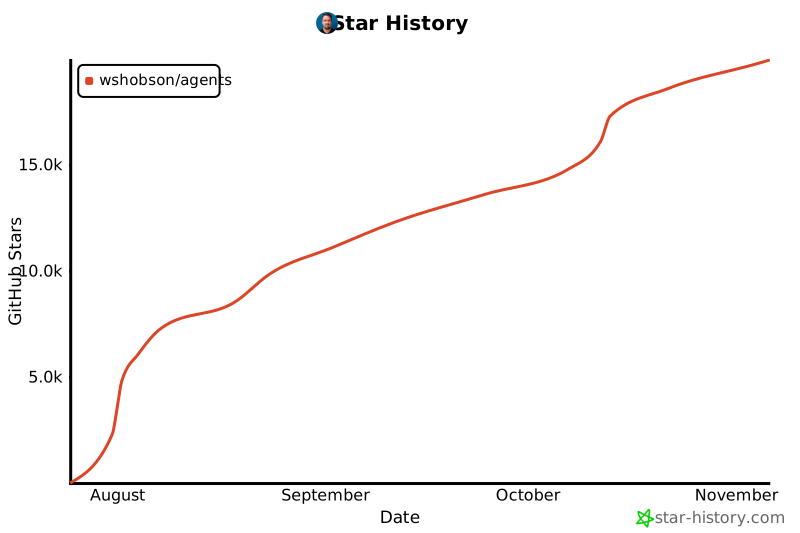
Star History